

Car lovers and hardcore gearheads alike are under no illusion about how dramatically Electronic Fuel Injection (EFI) has reshaped the high performance automotive landscape beyond carburettors. That’s because even though there’s no substitute for the roar of a big carb ingesting as much as 40m3/min of air at wide open throttle, the fact is fuel injection is an infinitely less finicky and ultimately more effective means of delivering fuel.
There’s no fuel wasted with fuel injection, ensuring the volume of fuel fed into the engine with each injector’s opening and closing duty cycle is precise. For reference, a well-built 2JZ turning 8000 RPM may be pushing as many as 70 duty cycles per second, per injector. That’s why injection is the most efficient method of high performance fuel delivery – and also why when it’s time to replace or upgrade OE injectors, there’s no room for settling for second best.
Fixing Classic Fuel Delivery Difficulties With Modern Fuel Injection
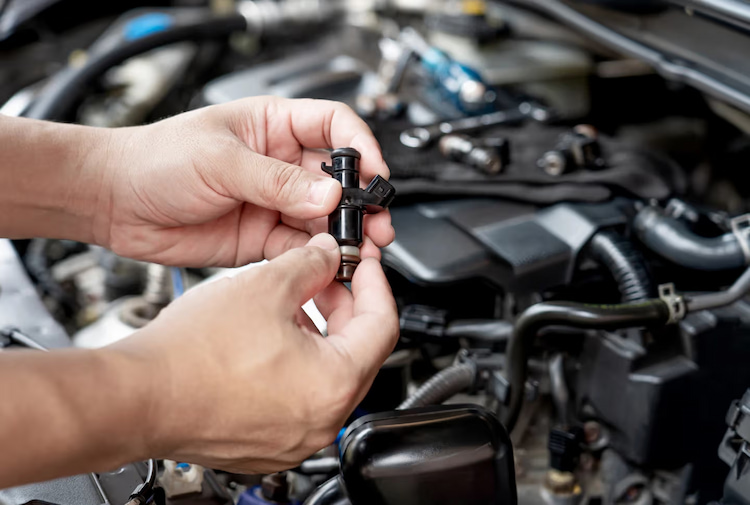
source: meineke.com
From their vastly improved fuel economy and lowered emissions, to their smoother and more consistent fuel delivery under wide open throttle, modern fuel injection systems, backed by today’s high performance fuel injectors are the solution to every engine builder’s fuel delivery problem.
Instead of the inconsistent vacuum-style fuel delivery used by carbureted systems for the last century, injection-style systems are pressurised and ECU-controlled for optimum performance. The resulting fuel deliver is smoother, faster and more reliable, especially under the following high performance conditions:
- Heavy vibration. The gaskets, float needles and multitude of fuel jets inside a heavy-bodied carb are prone to becoming disconnected or dislodged when subjected to heavy vibration. The rigid, solidly packed bodies of today’s high performance fuel injectors contain very few mechanical parts and are secured in such a way that they’re not affected by even the most severe powertrain vibration.
- High speed fuel starvation. Because carburettors take in fuel at atmospheric pressure, any drop in fuel delivery due to changes in pump pressure or vehicle acceleration can cause an engine to experience fuel starvation. The constant pressurisation of auto fuel injectors guarantees the engine will always have enough fuel in the line to avoid running rough or stalling.
- Vapour Lock. Vapour lock occurs when liquid fuel inside the fuel line becomes hot enough to vaporise, forming air pockets that restrict smooth fuel delivery. The high constant line pressure retained by fuel injection systems, even when the engine isn’t running, is crucial for preventing fuel from vaporising and creating its own fuel starvation issues.
For all its advantages though, fuel injection does rely on complex wiring, and multiple engine and throttle sensors to give it the crucial timing inputs that are needed to perform flawlessly. This is where the compact size and ECU-controlled functionality of car fuel injectors really sets injection apart. Only fuel injected systems have ability to adapt to hundreds of real-time variables to deliver perfect fuel volumes to every cylinder at all times. And unlike carburettors, fuel injectors can be easily swapped out and electronically coded to meet changes in regulatory, market and even driver demands.
Recognising the Differences Between Fuel Injection Types
Regardless of whether its off-roading, high-speed drifting, or just low-speed cruising, only fuel injection offers the full-time performance, efficiency and economy that’s expected with modern combustion engines. And make no mistake: injection’s ability to instantaneously adjust to steep angles and centrifugal forces, as well as to not waste fuel while idling are due almost entirely to advancements in fuel injector technology.
There’s been a variety of hybrid fuel injection systems used over the decades, especially on high performance engines. Most – and certainly the most reliable – fall within the four primary fuel injection and car fuel injector types that would be installed on every standard automobiles:
- Throttle Body Injection (TBI). TBI, also known as single point injection, was first used in 1980 and employs one or two auto fuel injector bodies attached to a central rail that sprays fuel directly into the intake manifold before it’s drawn into each cylinder.
- Multi-Point Fuel Injection (MPFI). MPFI came to prominence during the 1980s and 1990s, and was the first injection type to place a single fuel injector next to each cylinder’s intake port, but with the injectors set to fire in groups, not individually.
- Sequential Fuel Injection (SFI). SFI is effectively the same as MPFI and was also developed during the same period. The difference, however, is instead of the injectors firing in groups, they’re programmed to fire in line with the engine’s timing sequence.
- Gasoline Direct Injection (GDI). GDI has been the defacto standard for injection systems since the early 2000s, and is distinguished by aiming the fuel injector and all fuel injector accessories directly into the combustion chamber, allowing each air/fuel charge to produce the most power.
Invariably, as ECU processor speeds have increased, auto manufacturer performance levels have expanded, and even emission and fuel economy rules have tightened. The fuel injection systems, along with the quality and reliability of aftermarket high performance fuel injectors for sale, have also had to change.
And as early TBI and MPFI injectors are all likely experiencing difficulties, the urgency for EFI-equipped vehicle owners to buy fuel injectors that are suitable for modern use has never been greater. Fortunately for Aussie car owners, the range of upgraded high performance fuel injectors online has also never been greater.
Online Availability Helps Simplify Buying High Performance Fuel Injectors
With one of the broadest markets for high performance Bosch, Denso and VDO Siemens fuel injectors and fuel injection accessories anywhere, Aussie owners are able to buy fuel injector parts locally for practically any EFI-equipped car in Australia. From 200-Series Land Cruisers and 2JZ Supras, to Australia’s own big-block VZ Commodores and turbocharged FG Barras, there’s an injector available for any engine in stock, or upgraded trim – and they can be purchased online without ever leaving the comfort of home.
Practically any size or flow rate of fuel injector for sale can be ordered online, giving high performance engine builders and DIYers alike a bevy of benefits that include:
- Trust and confidence when buying. Instead of calling or driving from one shop to the next to find what they’re looking for, engine builders and tuners can buy their fuel injectors, buy injector accessories, and even complete systems in confidence from trusted online retailers who specialise in EFI components, and can vouch for their compatibility with other systems.
- Access to digital services. Not only does ordering injectors online give tuners visibility to multiple manufacturers’ complete product lines, but also full access to critical digital data like injector flow rates, latency info and other premium ECU tuning specs.
- The best possible pricing. Because online retailers aren’t burdened with costly overhead and showroom expenses, they’re able to offer the best OE and aftermarket injectors and injection systems at discounted prices that wouldn’t be possible from storefront retailers.
Ideally, when it comes to shopping for fuel injectors, Australia doesn’t just have one of the biggest selections; it also has one of the most established online supplier bases on the planet. It’s the simplified solution for the auto industry’s most effective type of fuel delivery systems.
The Final Word
At the end of the day, while EFI-equipped cars may lack the adrenaline-packed appeal that their carburettor-equipped counterparts have, the fact is, fuel injection out-performs carburation at every level. The challenge, however, especially for older EFI-equipped car owners, is ensuring that their injectors are delivering their best performance at all times. Internal coils, valve needles and O-rings can degrade over time, making upgrading injectors a smart, cost conscious move that no one should put off.
Modern, high performance fuel injectors are the key to restoring, as well as enhancing automotive performance. They’re the last word in efficient, cost-effective fuel delivery.